Endurance

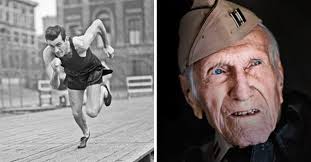
At the age of 19, Louis Zamperini  qualified for the 5000 meter run, earning  a place in the 1936 Summer Olympics in Berlin, Germany.  

In 1941, with the world in the throes of global conflict, Louis enlisted in the United States Army Air Force, earning  a commission as a second lieutenant and deployed to the Pacific as a bombardier.  While on a search for a lost aircraft and crew  in 1943, mechanical difficulties caused Zamperini’s  plane to crash into the Pacific Ocean,  850 miles west of Oahu, Hawaii,  killing eight of the eleven men aboard. 

With little food and no water, Zamperini, Russell Philips and Francis McNamara subsisted on rainwater and small fish eaten raw.   After 33 days at sea, McNamara succumbed to their ordeal, leaving Zamperini and Philips alone and adrift. 

On the 47th day, Zamperini and Phillips reached the Marshall Islands and found themselves captive of the Japanese Navy. Following 42 days of internment there, they were transferred  to the Japanese prisoner-of-war camp at Ōfuna, then  on to Tokyo’s Ōmori POW camp, and eventually, to the Naoetsu POW camp in northern Japan. 

One particular guard wanted to make an example of the eternally optimistic Olympian Zamperini. “The Bird” – as he was called – dedicated the next two years  to breaking Louis, physically, mentally, emotionally and spiritually, through verbal and physical cruelty.

Yet Zamperini remained; unbroken.   

What was it that bound him together?  The strength, stamina and training of an Olympic athlete?  

What enabled him to handle both the duress of being lost in the Pacific and the abject terror of internment at the hands of a cruel enemy?   

To find the will to endure.  To exert himself for a long period of time, resisting, withstanding and recovering  from fatigue, trauma and even wounds of the physical, mental, emotional and spiritual nature.

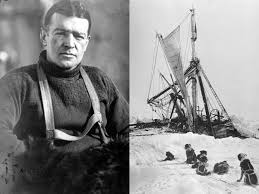
 When Sir Ernest Henry Shackleton left South Georgia Island on December 5, 1914 in a bid to be the first to cross the Antarctic continent, no level of preparation could have anticipated the challenges that would confront he and his crew of 28. 

Disaster struck the expedition early when its ship, Endurance,  became trapped in pack ice and  was slowly crushed. For nearly two months, Shackleton’s team camped on a large, flat ice floe, hoping that it would drift towards Paulet Island, approximately 250 miles  away.  

Several failed attempts to march across the ice led them to encamp  on another floe entrusting  the drift would take them towards a safe landing.  By mid March, Patience Camp was within 60 miles of the island, yet still separated by impassable ice. In early April the floe split, leaving Shackleton no option but to order the crew into the lifeboats. 

Five harrowing days at sea later, the exhausted men landed their three lifeboats at Elephant Island, 346 miles from where the Endurance sank. This would be  the first time they had stood on solid ground for 497 days. Nearly another year would pass before Shackleton and his entire crew could begin their journey back home.  

What was it about Sir Shackelton that continually rallied  him from within despite his expedition’s dire straits?

Talent?  Ability?  

Belief?  

Or  – some quality? 

A nature that allowed  an uncommon level of patience to guide him, enabling  him to remain calm, centered, deliberate,  and on task?

What set them apart is that Zamperini and Shackleton found a way – within themselves – to transcend their circumstances, even though both were captive to unforgiving environments that offered very little to support any form of life.  

They each  possessed a state of mind reinforced by  an unparalleled level of emotional and spiritual resilience.   

Reinforced by a belief in themselves – and others – that grew into something far  more than just a feeling.  

More than perseverance.  

Faith.  

Perseverance squared.  

That point you reach  where  you just “know”. 

That place you get to –  where you can accept, act, move forward and achieve – even the unimaginable  – because deep inside – you just know.    

Being stripped down to their core by their circumstance – whether on the ice or as a POW – did  not mean failure or defeat for Shackleton and Zamperini. 

Nor does it for you. 

For each trying or unforgiving  circumstance we enter, cross and exit  has within it a specific purpose.  

To remove some of your layers.  The veneer that can accumulate over time and diminish  some of your best features.  

And persevering through adversity is how they come to be stripped away.  Revealing  the best that you are – even when you think you are at your worst.   .  

Even as you  find yourself in the midst of a wide, inhospitable expanse or within the  emptiness of confinement, and those moments begin to close in about us, just remember.  

All is not lost.

With some courage, you need not merely drift or be held hostage.   

You can access that transcendent quality that powers your ability to persist.  

Your own will generator. 

To do more  than just simply hang on.  Merely get through it.  Or survive.  

 A level of perseverance that leads you to embrace those unforgiving circumstances.  

To find some way to somehow thrive despite the intensity of the adversity.  

To become more than what you were at the start.  

Because you just know it.
Always

“In order to have what you really want, you must first be who you really are.”

Tim S. Grover, author of –  “Relentless”

It is in adversity – those seemingly random moments, situations, challenges and circumstances – where you are pressed relentlessly to be who you really are.  It is in those times where the faint of heart will tend to bail, rationalize, make an excuse, pretend it wasn’t for them or just plain quit.  

It is in those times when you will not get what you really want because of your chosen response.  By choosing not to be who you really are, the result will be an outcome you never desired. 

One thing I know that is certain and indisputable: in all adversity therein lay opportunity.  

Not simply to overcome, achieve, succeed and win.  But more so to be who you really are.  To show the world how you are made, what you are made of and what you intend to do with it.

So as this day passes and becomes the next, remember this one thing: 

In order to have what you really want, you must first and always be who you really are.  

In all ways.  

And always.

Choose.

I want to circle back  to a gem I love from James Allen:

“Let a man radically alter his thoughts, and he will be astonished at the rapid transformation it will affect in the material conditions of his life. Men imagine that thought can be kept secret, but it cannot; it rapidly crystallizes into habit, and habit solidifies into circumstance.”  

This is a keen insight, built upon thought, habit and circumstance.  A genuine pattern of consequence with a lasting resonance.  An interconnectedness solely made by  and accountable to you. In certain respects, how your character is woven into a pursuit of excellence.

Then, how you choose to follow a suggested path governed by three simple questions.

#1 What thoughts hold you back?   

Is it  fear?  

Like it isn’t  within you to start? Or is it the avoidance of commitment; that it is too much to see it through. To finish.

Perhaps it is all about the unknown.  The possible uncertainty of the  outcome that dogs you.  The daunting spectre of disappointment. Discouragement’s inherent distractions. Disapproval. And ultimately, defeat.

Maybe it is the fickleness of change. A need for security. The inability to trust.  An aversion to honesty or criticism.  Selfishness. Arrogance. Ego.  Misperceptions about the call for leadership. Misconceptions about its demands for constant, unrelenting accountability, presence and effort.

And despite your efforts at containment, your thoughts rarely remain secret.

Your doubts are truly, traitors.

By word or deed, they make their way to the surface.  A little here, a little there. Followed by a hitch, the glitch, the sticking points, avoidance. Soon, all at once, you become an open book.  Your once private thoughts, come to govern habit, control action, impede achievement and prohibit excellence, all in a very public manner.

#2 What are you willing to do to change?

Not simply a change for change’s sake.  But renewal with the highest intention. The reclamation of a positive and fulfilling future through the development of the requisite and lasting habits of this instant.

Making the choice to acknowledge, address and act upon constraints now – that prevent you from maximizing your capacity in the moments yet to come.

Engaging in an intensely personal process of assessment, evaluation, reassessment, reevaluation, until the change you aspired to achieve has been accomplished and received. 

Preparing yourself to begin the work, commit the resources, and transform the internal  obstacles  of your own creation into a method of optimizing opportunity and enhancing abilities, forging a path for your own pursuit of excellence.

Mustering a level of will, faith and fortitude to maintain and nourish sustained level action.

Finishing.   No matter what.

#3 – What will be different?  

What will you endeavor to become while on this path ?  Who will you be once you get there?

How will you fit into a much bigger picture?  What will your impact be?

And then once you get “there”, where do you go from that temporary point?

Crucial questions, requiring thought, fully employed vision and an honest examination of intent.

All of which leads to choice.  And then, ultimately transformative action. The very mass of your character, woven into the fabric of excellence.

There can be no secret to this pattern that you designed, made and upheld. 

Nor to the circumstances that only you helped to create.

Essentially, it all comes down to these three questions. 

And, how you choose to answer them.  

Choose wisely.  

Doubt

Mr. Shakespeare once wrote:  “Our doubts are traitors and make us lose the good we oft might win, by fearing to attempt.”  

Words which speak of an inner conflict common to us all.  A hand to hand combat engaged from within.  When aspirations to become and achieve come in conflict with the risk associated with escape from your current reality. 

When dreams are overrun  by a phalanx of “common sense” and  the little voice that whispers “Yes.  You can.”, becomes shouted down by, “What in the world are you thinking?”.

Yes, our doubts are traitors.  

Made to betray our efforts, our commitments and our character.  

Our doubts seek to cajole and finesse one into believing your best interests lay in accepting the security that might reside in the  present instead of embracing the possibilities  of what you can make to follow.   

Our doubts twist  events and circumstances so the only perspective is negative.   Presenting an appearance that  consequences are more evident and abundant than the opportunity that always resides on just the other side.  

Our doubts are the comforting arm around your shoulder you seek when you fail – before you even attempt to try.  They are the self generated distractions designed to let you off the hook.  The white noise of rationale, excuse and drama. 

James Allen once  put it: “Man is made or unmade by himself; in the armory of thought he forges the weapons by which he destroys himself.”

Yet we fail to realize that within that very same armory are housed the dies of your salvation, opportunity and excellence. 

For man “…also fashions the tools with which he builds for himself heavenly mansions of joy and strength and peace. By the right choice and true application of thought….”  (James Allen “A man thinketh”)

Doubt is ill suited to thrive when exposed to these elements.  

Doubt dissipates under the brilliance of vision and aspirations. 

Doubt will succumb to the intensity of purpose with intention.  

Ultimately, doubt is excised by excellence. 

So begin now. 

Cast the dies that will forge your tools.    

– Choose to live  as “who” you see yourself being.  

– Act as “what” you intend to become. 

– Imagine you are already  “where” you dream of going   

Equip yourself  to persist and persevere. Press beyond fear, dispense with the drama and accept expectations. 

Allow that “you just know it” sensation to take hold, and embrace a level of  faith that will enable you to  overcome an inertia borne of skepticism, reluctance and doubt. All the while generating palpable momentum, a sustaining source of strength and a heightened level of confidence. 

In a collaborative effort of thought, choice and deeds, each working in concert to affirm a  blueprint of how you will conduct yourself and pattern your life.

So be true to yourself with a firm and resilient loyalty.  

Never abide the treason of doubt.

Throughout

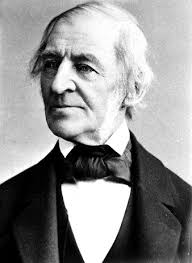
“The characteristic of a genuine heroism is its persistency. All men have wandering impulses, fits and starts of generosity. But when you have resolved to be great, abide by yourself, and do not weakly try to reconcile yourself with the world. The heroic cannot be the common, nor the common the heroic.” 

— Ralph Waldo Emerson 

The key aspect of his power thought is “..reconcile yourself with the world.” To be content to let things happen is to be common; to be reconciled with “fate” rather than commanding destiny. 

Those that choose another path embrace adversity, expend the effort, pay the price and persevere knowing that one day, it will be they that happens to things. 

Finding the heroic within requires the uncommon throughout.